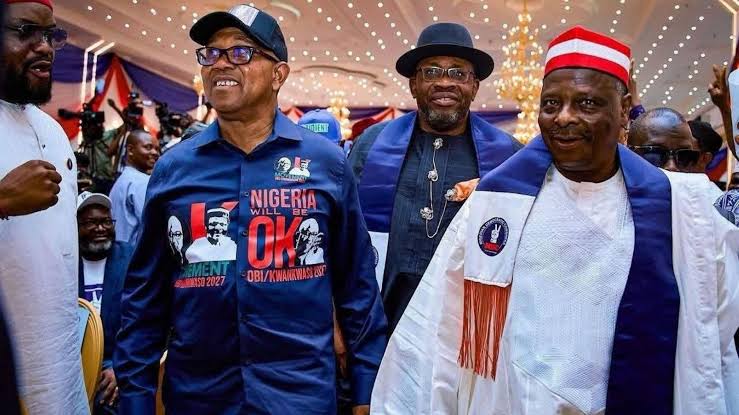
The Nigeria Democratic Congress (NDC) has unveiled a 118-member National Campaign Council as it steps up preparations for Nigeria’s 2027 general elections.
The council will be chaired by the party’s National Leader, Senator Seriake Dickson. The NDC’s presidential candidate, Peter Obi, will serve as co-chairman, while its vice-presidential candidate, Senator Rabiu Musa Kwankwaso, has been named co-vice chairman.
The party announced the appointments on Sunday, October 25, ahead of the council’s formal inauguration in Abuja on Monday, October 26.
The development marks a new phase in the party’s efforts to organise its presidential campaign and coordinate political activities ahead of the elections.
According to reports by Premium Times and Channels Television, the council brings together party leaders and other political figures who will oversee campaign planning, communication and mobilisation.
Ibrahim Abdulkarim Named Campaign Director-General
The NDC has appointed Ibrahim Hussain Abdulkarim as Director-General of the presidential campaign council.
Abdulkarim, an information and communications strategist and businessman from Kaduna State, is expected to coordinate the campaign’s activities.
The party’s National Secretary, Ikenna Enekweizu, will serve as council secretary.
Other appointments include former Secretary to the Government of the Federation, Babachir Lawal, who will chair the National Campaign Advisory Council.
Former Deputy Senate President Ovie Omo-Agege, Senator Victor Umeh, former presidential candidate Pat Utomi and Buba Galadima are also among the prominent figures listed in the campaign structure.
The NDC’s National Publicity Secretary, Osa Director, has been named Director of Media and Communication. Former defence spokesperson Major General John Enenche (retd.) will oversee security and intelligence.
The published structure also includes a 40-member National Campaign Advisory Council and campaign coordinators for the 37 state-level administrative areas, according to Channels Television.
NDC Promises People-Centred Campaign
The party said the National Campaign Council would provide strategic leadership, coordinate campaign activities nationwide and mobilise support for its political programme.
The NDC described its proposed campaign as “people-centred and issue-based”, saying it would promote its vision of a new, just and prosperous Nigeria.
The appointments place senior party figures and the presidential and vice-presidential candidates in key positions within the campaign structure.
However, the announcement alone does not establish how effectively the council will operate across the country. Its performance will depend on campaign coordination, communication with voters and the party’s ability to organise and sustain its activities at grassroots level.
Obi-Kwankwaso Movement Questions Campaign Preparations
The announcement has also drawn criticism from the Obi-Kwankwaso Movement, popularly known as the OK Movement.
In a report published on October 26, Blueprint quoted the movement’s Director-General, John Ughulu, as questioning the timing of the council’s unveiling and the NDC’s grassroots mobilisation arrangements.
Ughulu argued that a successful campaign required sustained mobilisation and coordination, rather than relying primarily on prominent names in a campaign structure.
The disagreement reflects a dispute over the relationship between the NDC and the movement, including the role of the movement’s own campaign structure. The criticism represents the movement’s position; it does not independently establish the strength or reach of either organisation’s grassroots network.
The issue could become relevant as the party works to coordinate its campaign leadership and the wider network of supporters associated with Obi and Kwankwaso.
What the Campaign Council Means for 2027
The unveiling gives the NDC a formal national structure for managing its campaign ahead of the 2027 elections.
With Dickson overseeing the council, Obi serving as co-chairman and Kwankwaso taking the co-vice-chairman role, the party has placed its leading figures within the campaign’s central leadership.
The next test will be translating the appointments into coordinated activities across the states, communicating clear policy proposals and engaging voters on issues affecting their daily lives.
Nigerians will also be watching how the party addresses concerns around the economy, employment, security, public services and other major national issues as political competition intensifies.
The NDC’s announcement is one development in the wider preparations for 2027. The council’s effectiveness and the party’s eventual electoral performance remain to be determined.