
President Bola Ahmed Tinubu has expressed confidence in Nigeria’s economic future following the remarkable growth of the Nigerian Exchange (NGX), whose total market capitalisation has risen to N160 trillion, describing the development as a strong indication that the country’s economic reforms are yielding positive results.
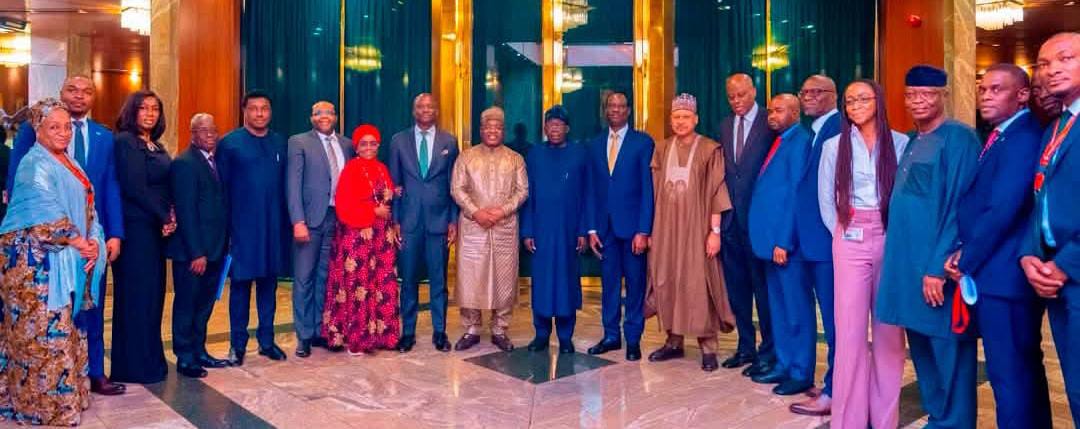
Speaking on Thursday while receiving the Board and Management of the Nigerian Exchange Group (NGX) at the Presidential Villa in Abuja, the President said his administration’s economic policies, anchored on globally accepted best practices, have created a solid platform for sustainable economic growth and long-term prosperity.
During the meeting, the NGX delegation, led by Chairman Dr. Umaru Kwairanga and Group Managing Director/Chief Executive Officer Temi Popoola, informed the President that the value of the Nigerian stock market had expanded significantly from approximately N30 trillion in 2023 to N160 trillion, reflecting growing investor confidence in the economy.
Reacting to the development, President Tinubu commended members of his economic management team for their commitment to implementing critical reforms aimed at stabilising the economy and restoring investor confidence.
He specifically praised the Minister of Finance and Coordinating Minister of the Economy, Taiwo Oyedele, the Minister of Budget and Economic Planning, Senator Atiku Bagudu, the Governor of the Central Bank of Nigeria (CBN), Olayemi Cardoso, and the Chairman of the National Revenue Service (NRS), Dr. Zacch Adedeji, for their contributions to the country’s economic turnaround.
The President acknowledged that his administration inherited significant economic challenges but stressed that difficult policy decisions were necessary to reposition the economy for sustainable growth.
According to him, the impressive performance of the capital market reflects broader improvements across Nigeria’s economic landscape and reinforces confidence that the country’s ambition of building a $1 trillion economy remains within reach.
Tinubu also disclosed plans to reform the Nigerian National Petroleum Company (NNPC) Limited, with the long-term objective of listing the national oil company on the Nigerian capital market.
He reiterated that the private sector remains a critical driver of economic expansion and assured investors that his administration would continue to create an enabling environment that supports business growth, attracts investment and generates employment.
Earlier, Finance Minister Taiwo Oyedele described Nigeria’s stock market as one of the strongest-performing markets globally, attributing its impressive performance to the government’s reform agenda.
He encouraged more Nigerians, particularly young people, to take advantage of investment opportunities available in the capital market instead of focusing primarily on speculative ventures and gambling.
Oyedele also advocated reforms that would simplify the process for companies seeking to list on the exchange, while urging the NGX and the Securities and Exchange Commission (SEC) to work towards expanding the market to a $1 trillion valuation.
Speaking on behalf of the NGX, Dr. Umaru Kwairanga said investor confidence has strengthened considerably since the implementation of the Federal Government’s economic reforms.
He noted that discussions with international investors, including engagements at the London Stock Exchange, revealed growing global interest in Nigeria’s improving economic outlook.
Providing additional insights, Temi Popoola disclosed that the NGX All-Share Index had climbed from approximately 52,000 points in 2023 to about 244,000 points, while projecting that total market capitalisation could rise further to N230 trillion before the end of 2026.
He added that the sustained market rally has created substantial wealth for Nigerians, estimating that between 500,000 and 900,000 investors have attained millionaire status through stock market investments.
According to Popoola, Nigeria’s capital market reforms are increasingly attracting attention across Africa, with several countries now looking to the NGX as a model for market development.
Also speaking, Dr. Zacch Adedeji, Chairman of the National Revenue Service, credited the administration’s tax reforms and fuel subsidy removal with correcting long-standing structural distortions in the economy and laying the foundation for lasting economic growth.
Meanwhile, CBN Governor Olayemi Cardoso said the successful recapitalisation of Nigeria’s banking sector has further strengthened confidence in the country’s financial system.
He revealed that despite initial concerns, about 75 per cent of the recapitalisation funding came from domestic investors, demonstrating growing local confidence in Nigeria’s financial sector and improving the country’s ability to attract long-term investment into the real economy.
About the Author