
The International Maritime Institute of Nigeria (IMION) and the Admiralty University of Nigeria (ADUN) have entered into a strategic technical partnership aimed at strengthening professional capacity, research, innovation and practical expertise within Nigeria’s maritime industry.
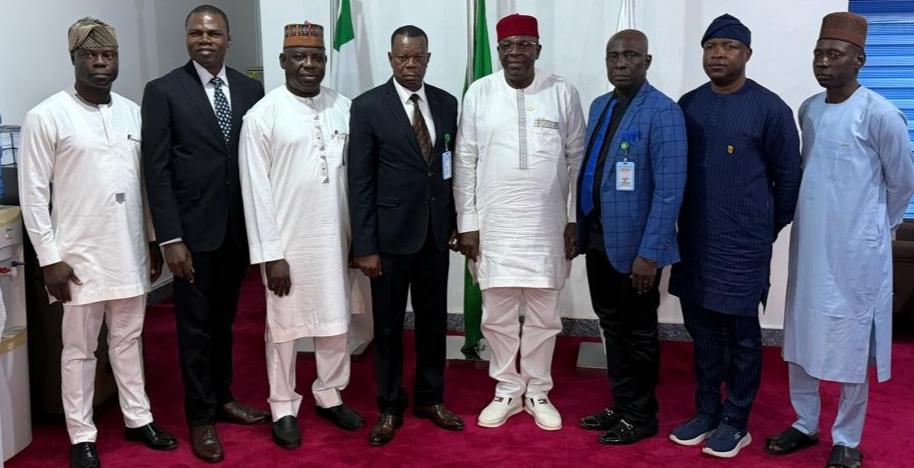
The collaboration was unveiled during IMION’s maiden official visit to the Admiralty University campus in Ibusa, Delta State, where both institutions held discussions on bridging the gap between academic training and the practical needs of the maritime sector.
In a statement issued on Saturday, the Head of Communications and Marketing at IMION, Dr. Bashir Ambi, said the partnership represents a major step towards strengthening indigenous expertise and preparing professionals to take advantage of opportunities within Nigeria’s growing blue economy.
During the visit, the Director-General of IMION, Rear Admiral Thaddeus Christopher Udofia (Rtd), presented the institute’s strategic roadmap to the Vice-Chancellor of ADUN, Professor Christopher Bankole Ndubuisi Ogbogbo.
Udofia described the partnership as an important milestone in efforts to develop local maritime capacity and unlock the economic potential of Nigeria’s marine resources.
According to him, the collaboration would create stronger institutional links between maritime education, industry practice and policy development.
“This visit marks a new vista in our quest for excellence,” Udofia said.
He explained that both institutions would work together to deepen local expertise, contribute to industry development and strengthen Nigeria’s ability to benefit from the enormous opportunities within the blue economy.
“We are engineering a powerful synergy to deepen local capacity, shape industry regulations, and unlock the immense billion-dollar potential of Nigeria’s blue economy for national development,” he added.
IMION Targets Stronger Maritime Expertise
Udofia also commended the Admiralty University for its infrastructural development and ongoing modernisation, describing the transformation of the institution as impressive and strategically significant.
Established by the Nigerian Navy in June 2024, IMION has trained more than 500 C-suite executives and senior government policymakers.
Under the new partnership, IMION and ADUN will introduce specialised executive programmes designed to expand global maritime knowledge and translate academic learning into practical solutions for the industry.
The first phase of the collaboration is expected to begin in September 2026.
As part of the partnership, IMION has invited members of the university’s leadership to participate in its Executive Course on “Logistics and Trade Facilitation for Blue Economy Growth.”
The three-day programme is scheduled to hold from September 7 to 9, 2026, at the IMION Auditorium, NNS QUORRA Complex, Apapa, Lagos.
The programme will also accommodate hybrid and virtual participation for local and international participants.
ADUN Welcomes Partnership
Responding, the Vice-Chancellor of Admiralty University, Professor Ogbogbo, described the partnership as timely and consistent with the institution’s commitment to manpower development and capacity building.
He said ADUN would benefit significantly from IMION’s practical industry experience, opportunities for collaborative research and advanced professional development programmes.
According to him, the partnership would also create opportunities for distinguished maritime professionals, adjunct professors and visiting scholars to contribute to academic development at the university.
Ogbogbo further disclosed that students studying Naval Architecture at the institution would embark on educational visits to shipbuilding facilities in Lagos and Port Harcourt.
He said the tours would provide students with direct exposure to real-life shipbuilding operations and hands-on technical experience to complement their classroom education.
The partnership between IMION and ADUN is expected to strengthen the connection between maritime education, industry practice and policy development.
It is also expected to support Nigeria’s broader drive to develop indigenous maritime expertise and position the country to take greater advantage of investment and economic opportunities within the blue economy.
About the Author