

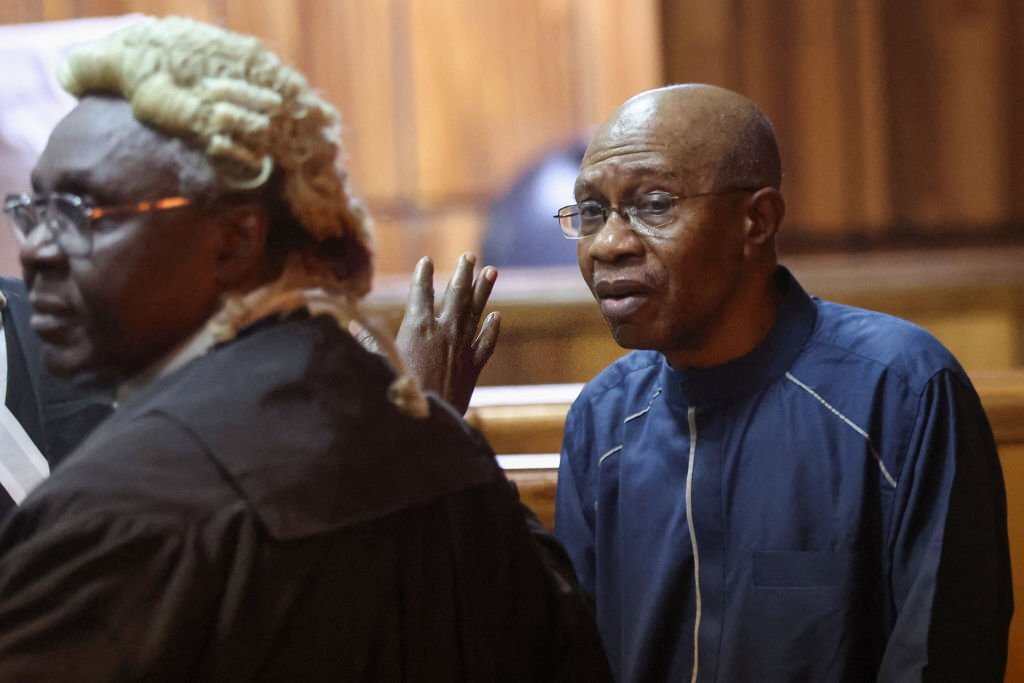
The Supreme Court of Nigeria has upheld the permanent forfeiture of several high-value properties, $2.045 million in cash, and share certificates linked to former Central Bank of Nigeria (CBN) Governor, Godwin Emefiele, bringing an end to a prolonged legal battle over the assets.
In a unanimous judgment delivered on Friday, July 17, 2026, a five-member panel of the apex court, led by Justice Ibrahim Mohammed Saulawa, overturned an earlier decision of the Court of Appeal and restored the ruling of the Federal High Court, Lagos, which had ordered the final forfeiture of the assets to the Federal Government.
The Supreme Court held that the properties were reasonably suspected to have been acquired through proceeds of unlawful activities, affirming the legality of the forfeiture proceedings initiated by the Economic and Financial Crimes Commission (EFCC).
Appeal Court Judgment Overturned
Following the Federal High Court’s forfeiture order in November 2024, Emefiele challenged the decision at the Court of Appeal, where the judgment was initially set aside in his favour.
However, dissatisfied with that outcome, the EFCC approached the Supreme Court, which has now reinstated the original forfeiture order, effectively returning the disputed assets to the Federal Government.
Assets Ordered Forfeited
The forfeited assets include seven prime real estate properties located in Lagos and Delta State, among them:
- A luxury detached duplex on Hakeem Odumosu Street, Lekki Phase 1.
- An undeveloped parcel of land on Oyinkan Abayomi Drive, Ikoyi.
- A bungalow and multiple duplexes in Ikoyi’s high-end residential district.
- Eight residential apartments on Adekunle Lawal Road, Ikoyi.
- An industrial complex under construction on 22 plots of land in Agbor, Delta State.
The court also ordered the permanent forfeiture of $2,045,000 in cash and share certificates belonging to Queensdorf Global Fund Limited.
EFCC Secures Major Victory
The anti-graft agency had argued that investigations showed the assets were acquired with proceeds of suspected unlawful activities.
The original application, filed under the Advance Fee Fraud and Other Fraud Related Offences Act, 2006, and relevant provisions of the Nigerian Constitution, was supported by evidence presented by an EFCC investigating officer, who stated that the properties and funds could not be legitimately accounted for.
With the Supreme Court’s verdict, the forfeiture order is now final, ending all legal disputes over the assets and marking another significant victory for the EFCC in its campaign to recover suspected proceeds of financial crimes.
The judgment reinforces the judiciary’s role in supporting asset recovery efforts and underscores the government’s commitment to strengthening transparency, accountability, and the fight against corruption.
About the Author